Part 1 of 3 | A 3-Part Series on Automating Proposal Generation with AI | Part 2 | Part 3
The Moment the Market Noticed
On February 4, 2026, something unusual happened. A software tool announcement triggered a trillion-dollar selloff across global IT and enterprise software stocks. The tool was Claude Cowork — Anthropic’s new desktop AI agent that can read documents, write reports, analyze data, and automate the kind of knowledge work that entire industries are built on.
The Nasdaq 100 slid 1.55% in a single session. A software industry ETF dropped nearly 6% — its worst day since April. But the shockwave hit hardest in specific corners of the market:
- Thomson Reuters saw its biggest single-day stock drop on record, plunging nearly 16%. LegalZoom sank 20%. Gartner fell 21%.
- ServiceNow dropped over 23% from its January highs. Salesforce, Workday, and IBM all took double-digit hits.
- In India, the Nifty IT index nosedived 19% in February — its worst monthly performance since the 2008 financial crisis. Infosys and Coforge each fell ~23%. TCS dropped 18%. Jefferies downgraded six major Indian IT firms to “hold” or “underperform,” citing AI-led disruption to the outsourcing model.
The fear wasn’t abstract. Anthropic’s industry-specific plugins demonstrated that AI could now automate precisely the high-volume, repetitive knowledge work that has been the bread and butter of enterprise software companies and IT outsourcing firms: contract reviews, regulatory compliance tracking, sales forecasting, COBOL modernization, and — notably — proposal generation.
By late February, the narrative began to stabilize. Anthropic repositioned its messaging toward “human augmentation” rather than “human replacement.” Gartner analysts pushed back on the panic, noting that predictions of SaaS obsolescence were premature. But the signal was clear: the tools are here, and the firms that adopt them first will have a structural advantage over those that don’t.
Which brings us to the question that matters for consulting firms, government contractors, and outsourcing companies: if AI can now do knowledge work, what does that look like for the people who respond to RFPs for a living?
Introducing RFP2Proposal
If you’ve ever stared down a 60-page government RFP at 4pm on a Friday, knowing the response is due Monday, this one’s for you.
RFP2Proposal is an open-source Claude Cowork plugin that reads your client’s RFP document, deeply understands every requirement inside it, and generates a complete, professional proposal draft — with smart placeholders, compliance checklists, and Word document export — in minutes instead of days.
Drop in an RFP. Get a proposal out.
GitHub Repository: github.com/agentbee0/RFP2Proposal
License: MIT (fork it, customize it, make it yours)
See It In Action: Sample Output Artifacts
Before we explain how it works, let’s show you what comes out. We fed a real-world-style RFP for an Enterprise CRM Implementation (from Acme Corporation) into RFP2Proposal. Here’s what it generated:
The Proposal Document (.docx)
A complete, professionally formatted 10-section proposal — ready to open in Microsoft Word, fill in the placeholders, and submit.

The title page pulls your company name, the client’s name, and the RFP solicitation number automatically from the analysis.
Download the sample: AcmeCorp-CRM-Proposal.docx
The proposal includes all 10 standard sections: Cover Letter, Executive Summary, Understanding of Requirements, Technical Approach, Management Approach, Staffing Plan, Past Performance, Pricing & Commercial Terms, Compliance Matrix, and Appendices.
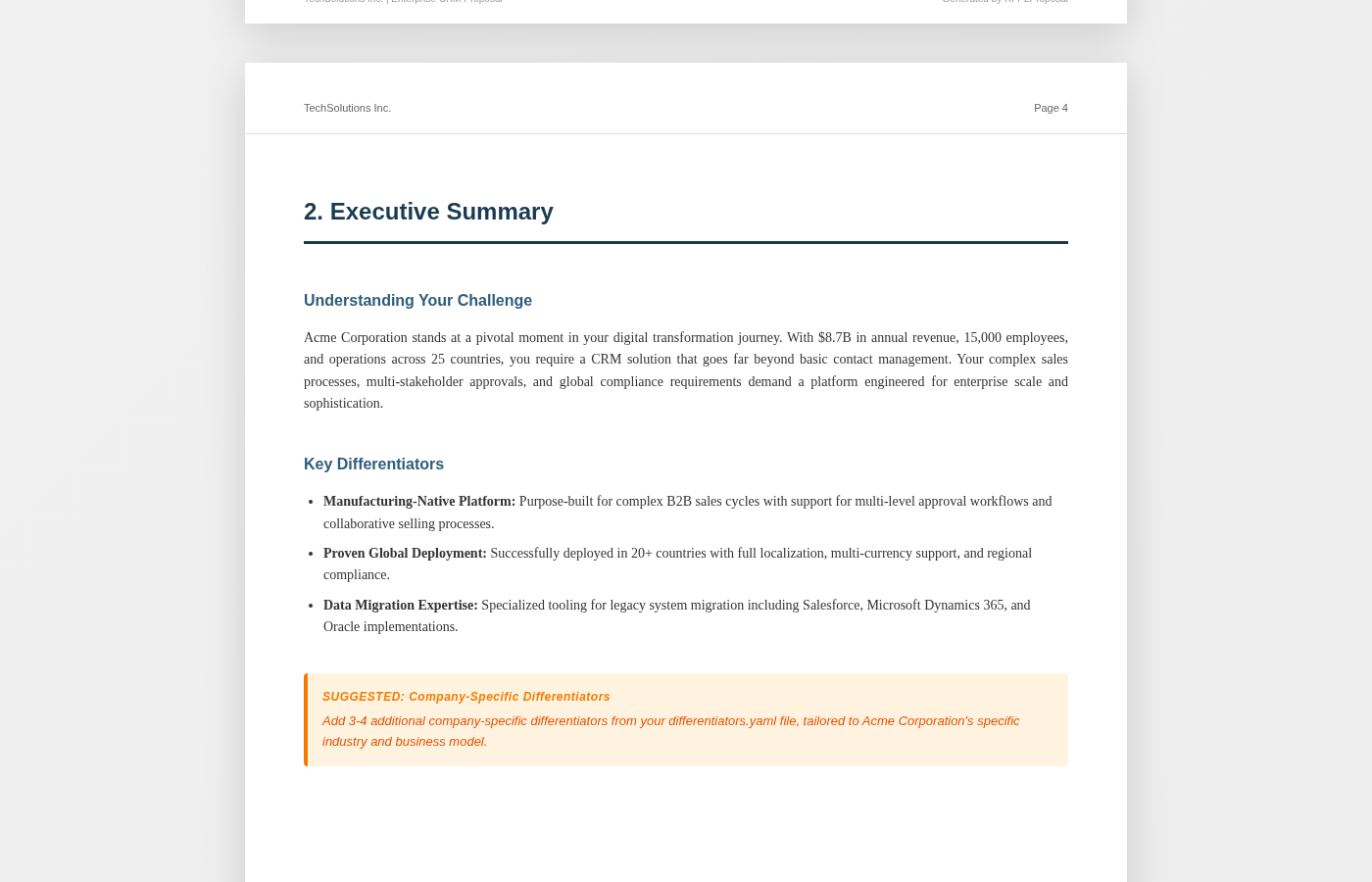
Notice the orange SUGGESTED placeholder: “Add 3-4 additional company-specific differentiators from your differentiators.yaml file.” The AI wrote the section framework and filled in what it could — then flagged exactly where your experts need to weigh in.
Smart Placeholders: The Three-Tier System
This is the feature that separates RFP2Proposal from generic AI writing tools. Not all gaps are equal, so the plugin uses color-coded placeholders with three urgency tiers:
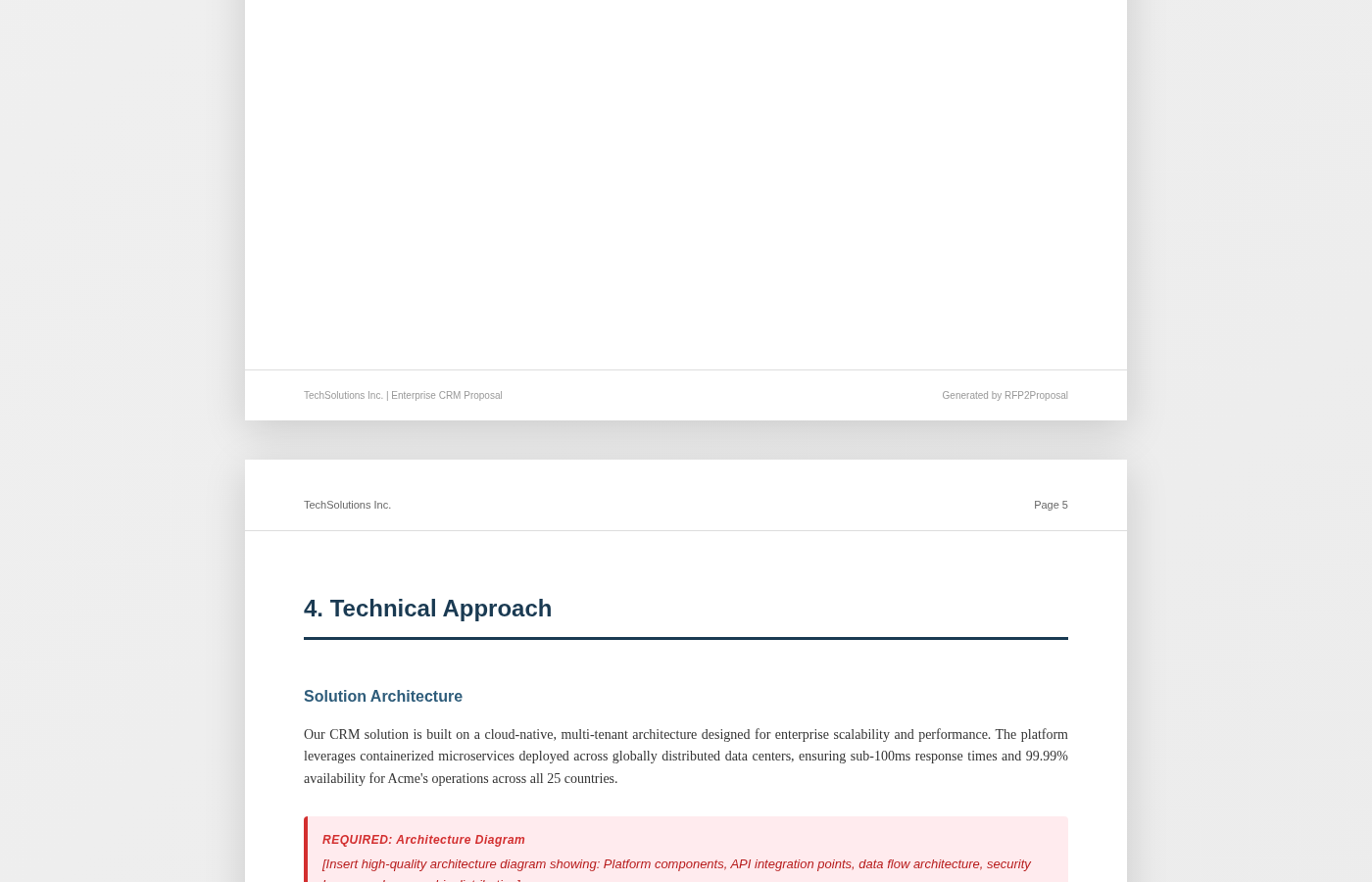
The red REQUIRED placeholder for “Architecture Diagram” is unmissable. Your team can’t submit without filling this in. The AI knows it can’t fabricate a diagram — so it flags it clearly instead of skipping it silently.
The three tiers at a glance:
- REQUIRED (Red) — Must be filled before submission. Pricing, named personnel, signatures, architecture diagrams. The proposal is incomplete without these.
- SUGGESTED (Amber) — Strengthens the proposal significantly. Additional case studies, company-specific differentiators, technology version details. Skip these at your own risk.
- OPTIONAL (Blue) — Nice-to-have enhancements. Client testimonials, awards, extended team bios. Include them if you have time.
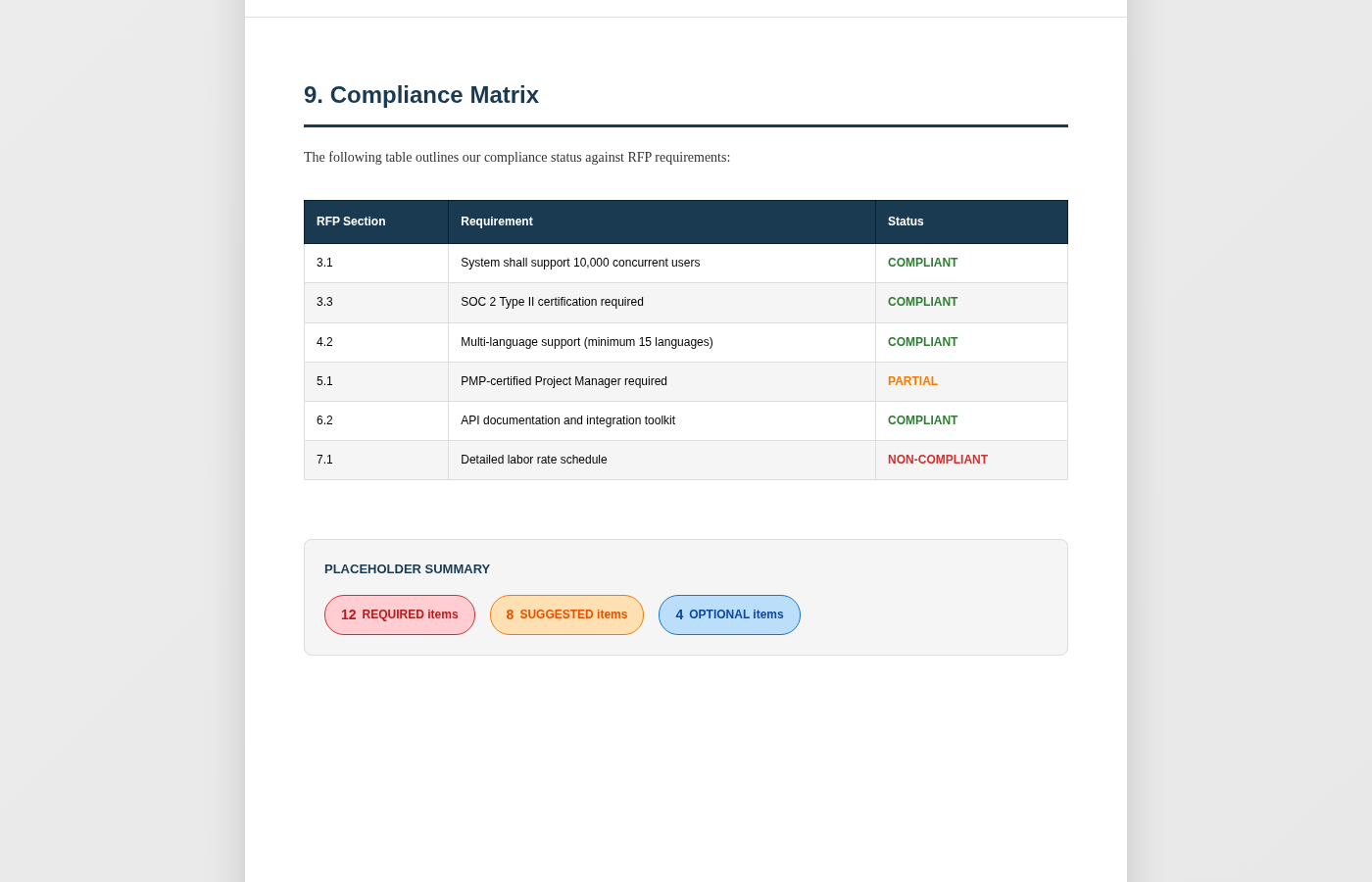
The Compliance Matrix (Section 9) maps every RFP requirement to a status. The Placeholder Summary at the bottom gives your team a clear action list: 12 must-fill items, 8 should-fill items, 4 nice-to-haves.
The Traceability Matrix (.xlsx) — The Crown Jewel
If the proposal is the answer, the traceability matrix is the proof that you answered everything. This Excel artifact maps every RFP section to the proposal section where it’s addressed, with color-coded coverage status.
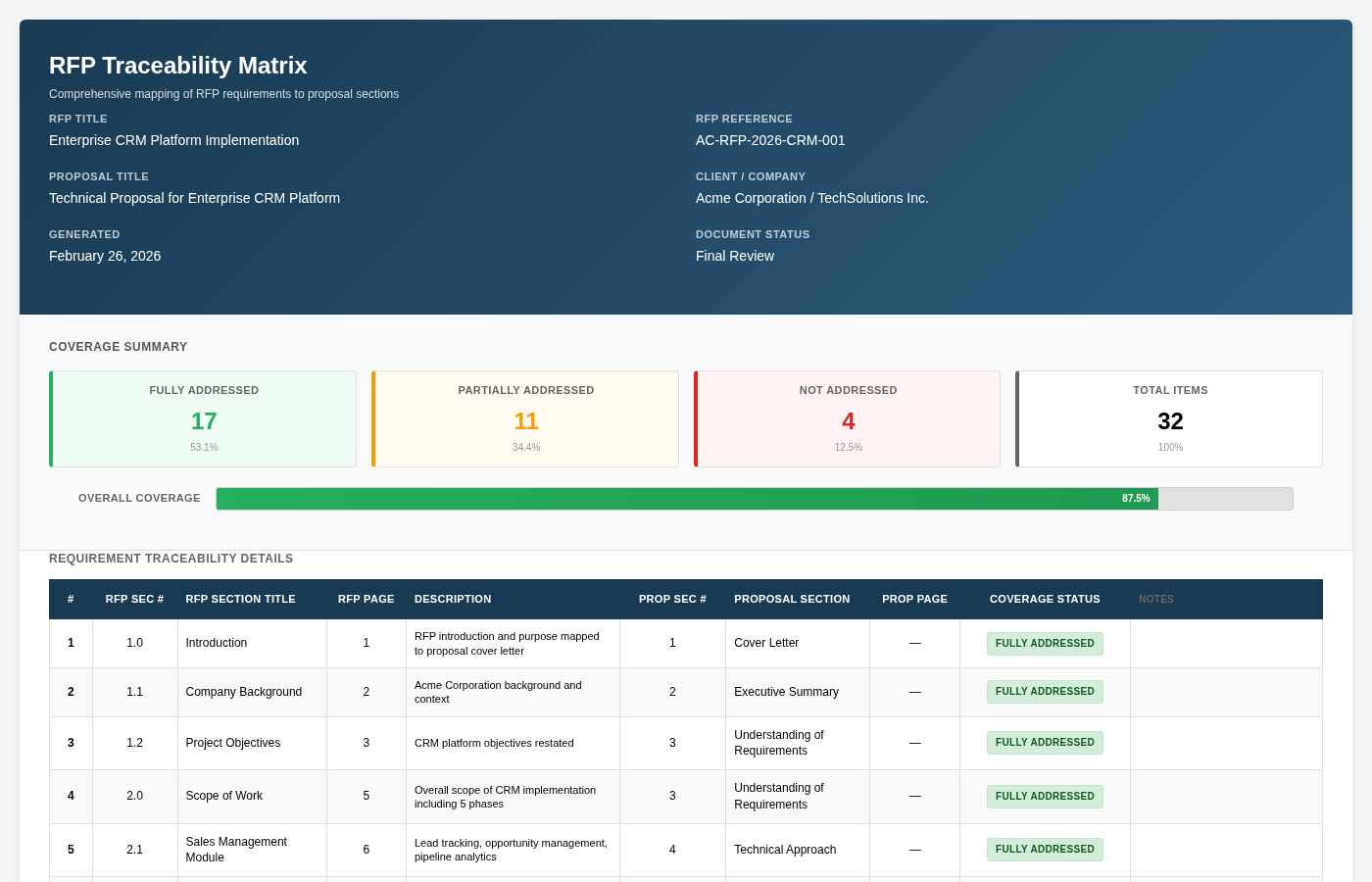
The coverage summary dashboard at the top gives instant visibility: 87.5% of the RFP is covered. 17 sections are fully addressed (green), 11 partially (amber), and 4 have gaps (red). This is the artifact that quality reviewers and proposal managers will live in.
Download the sample: AcmeCorp-CRM-Traceability-Matrix.xlsx
The matrix includes 32 rows mapping every substantive RFP section — from “1.0 Introduction” through “10.1 Insurance Requirements” — to the exact proposal section where it’s addressed. Scroll down and the gaps become immediately actionable:
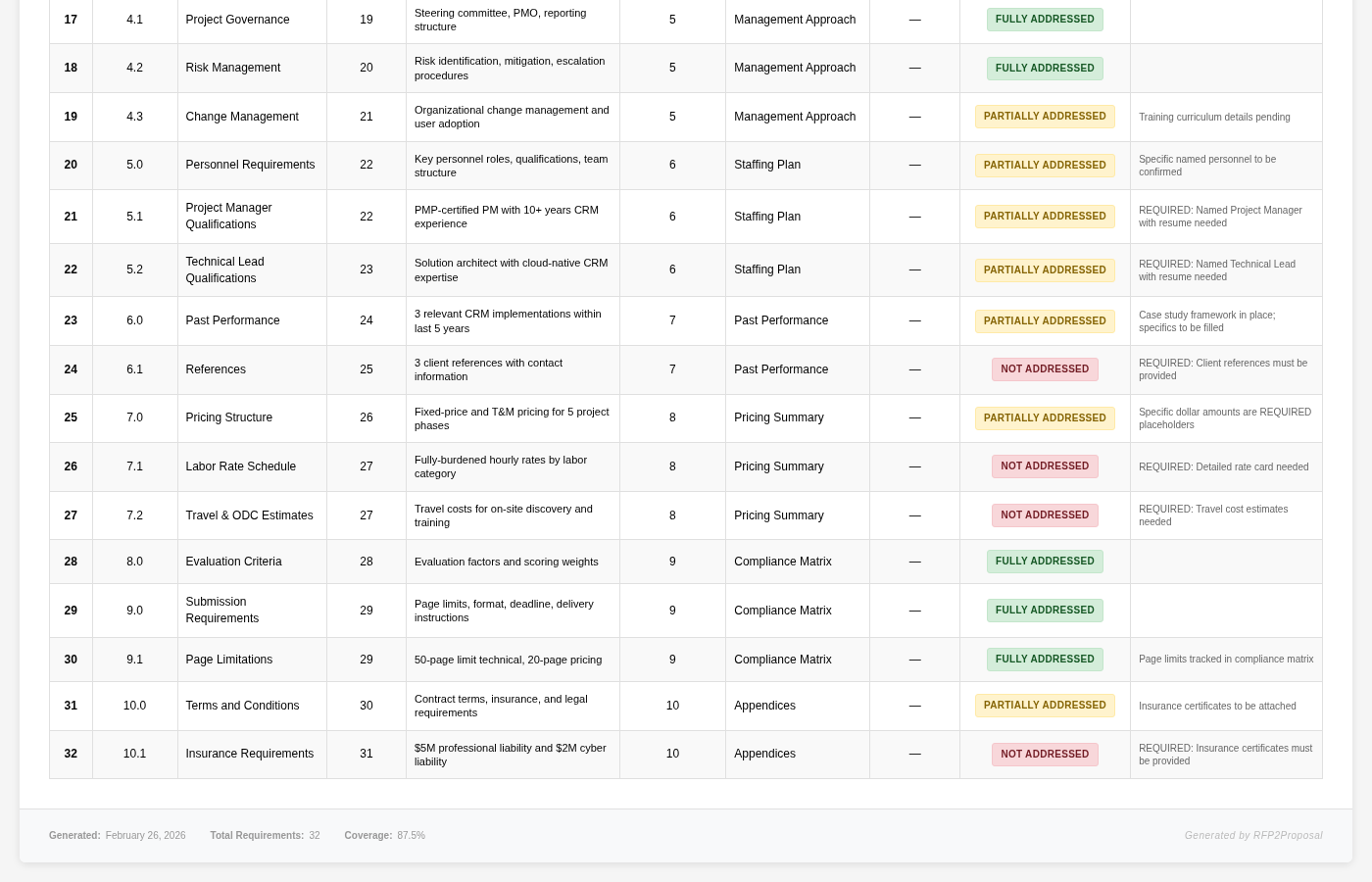
The bottom of the matrix tells the real story. References (6.1)? NOT ADDRESSED — client references must be provided. Labor Rate Schedule (7.1)? NOT ADDRESSED — detailed rate card needed. Insurance Requirements (10.1)? NOT ADDRESSED — certificates must be provided. Each red row has a specific note explaining exactly what’s missing and why.
This is the artifact that evaluators look for. A proposal without a clean traceability matrix gets downgraded before the evaluator reads your technical approach. RFP2Proposal generates it as a byproduct of the proposal creation process — not as an afterthought at 11pm.
Organization Knowledge: Your Company DNA, Structured for AI
Here’s the question every proposal team asks about AI writing tools: “How does it know about us?”
Most AI tools don’t. They write generic content because they have no context about your organization. RFP2Proposal solves this with its org-knowledge system — a set of structured YAML files that encode your company’s DNA so Claude writes in your voice, with your proof points, citing your actual case studies.
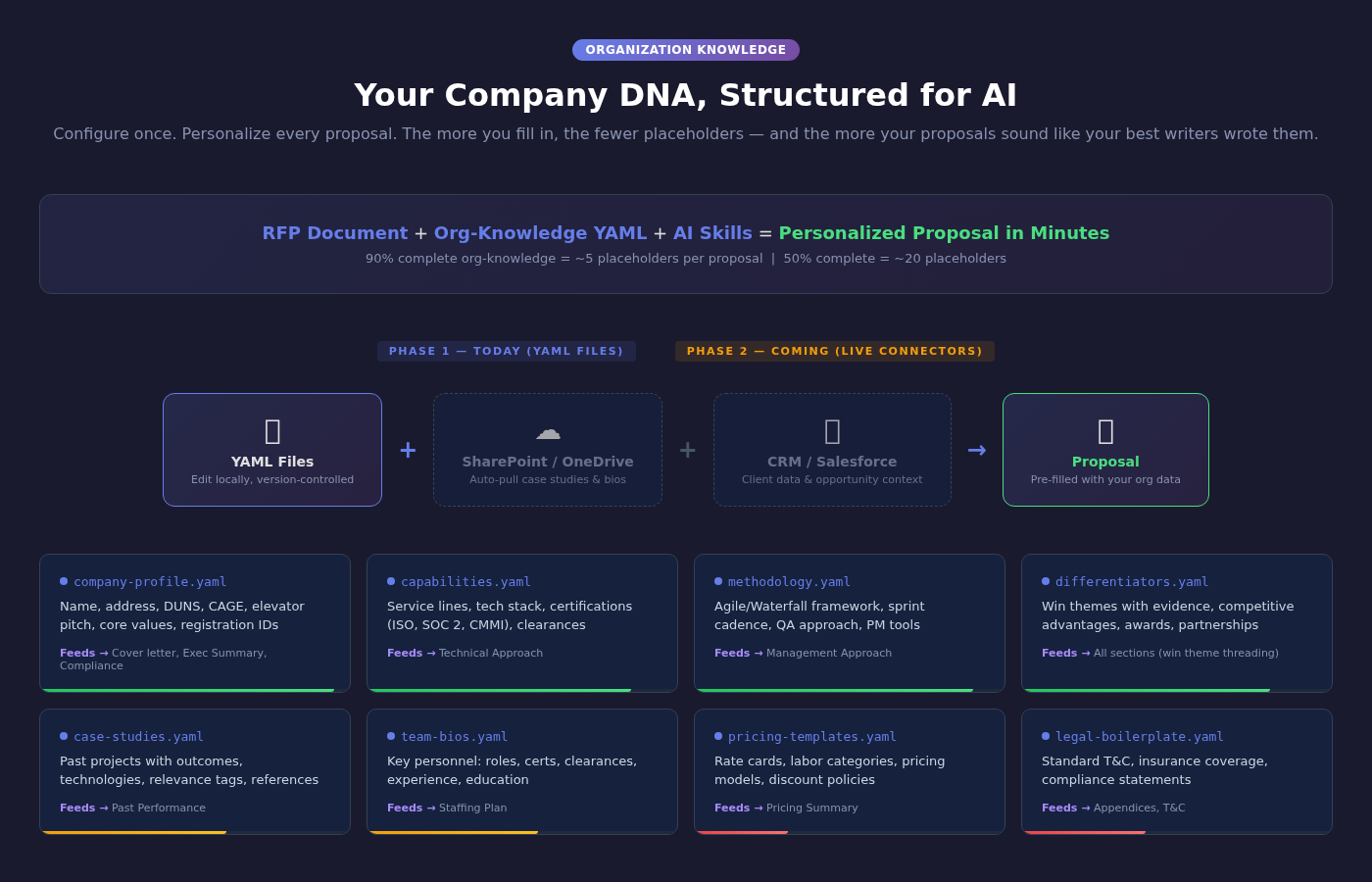
The formula is simple: the more org-knowledge you fill in, the fewer placeholders in your proposals. At 90% completion, proposals generate with only ~5 placeholders. At 50%, you’re looking at ~20.
Eight YAML files cover everything the plugin needs to write like your best proposal writer:
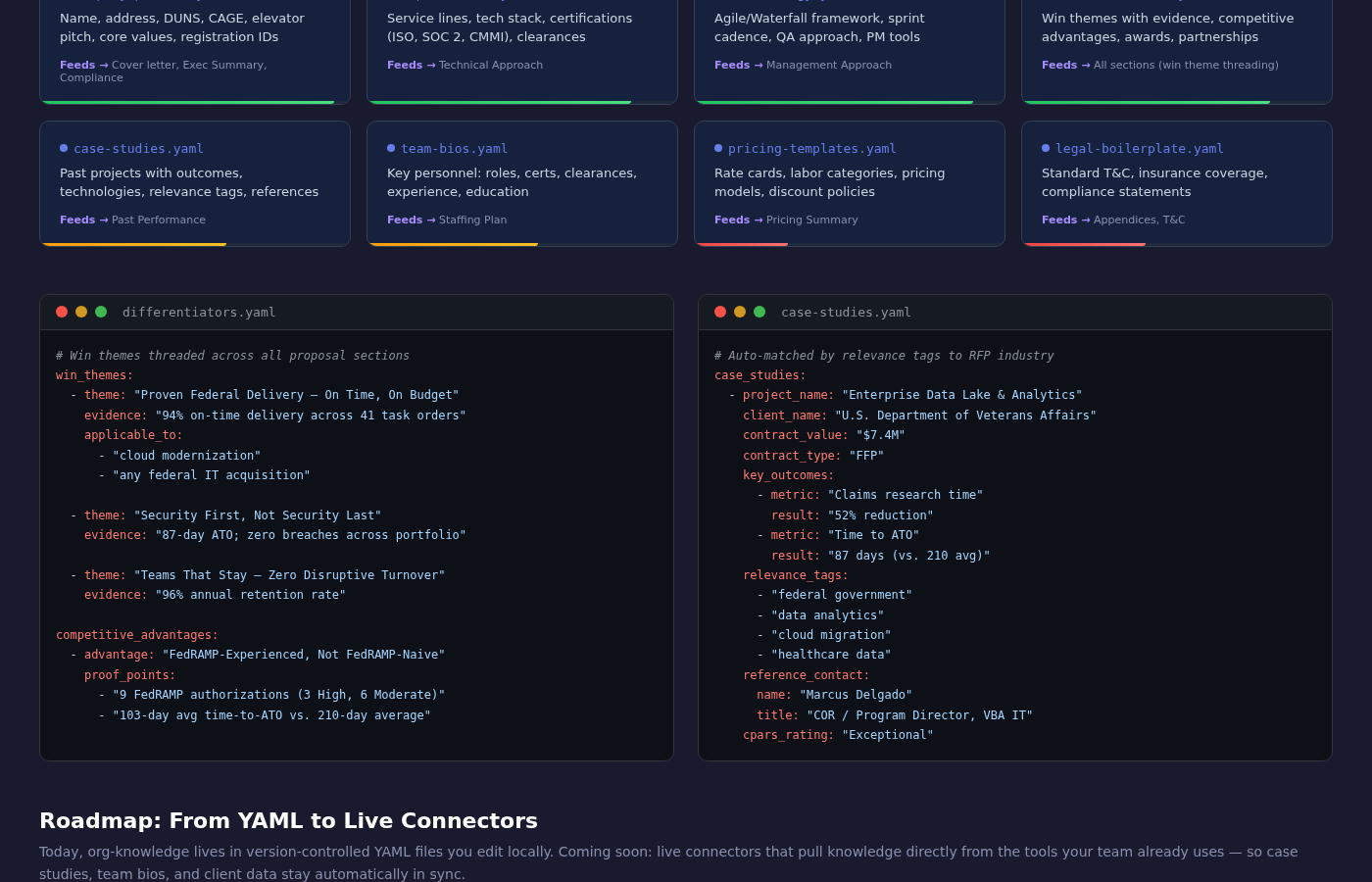
Each file maps directly to specific proposal sections. Your differentiators.yaml feeds win themes across ALL sections — introduced in the Executive Summary, substantiated in the Technical Approach, proven in Past Performance. Your case-studies.yaml includes relevance tags so Claude auto-selects the right case studies for each RFP’s industry and technology.
Here’s what the YAML files actually look like — structured, human-readable, version-controlled:
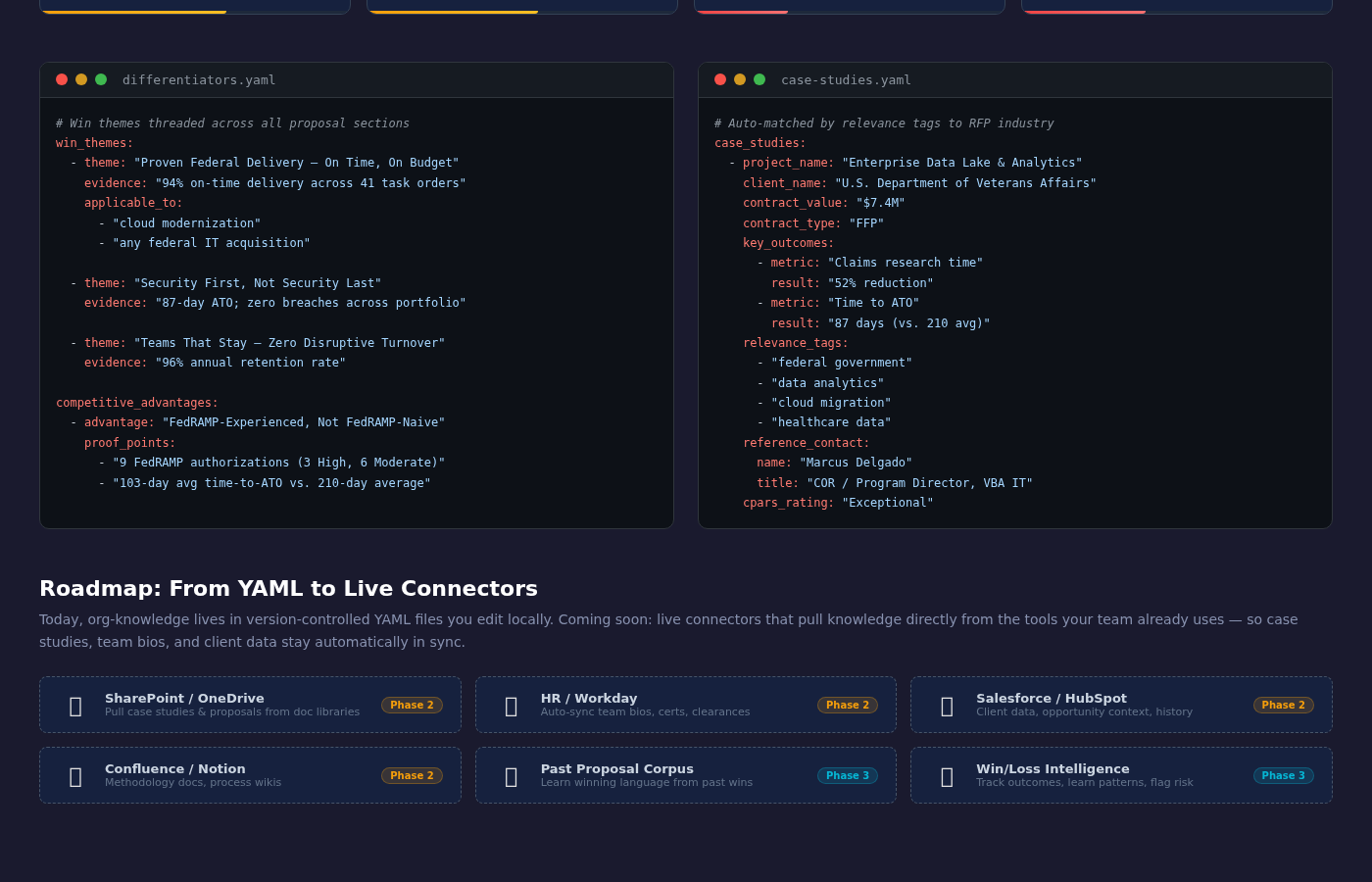
Left: Win themes in differentiators.yaml with specific evidence (“94% on-time delivery across 41 task orders”) and applicability tags. Right: A case study in case-studies.yaml with quantified outcomes, relevance tags for auto-matching, and a reference contact.
No code. No database. No API integration. Just YAML files you can edit with any text editor — or let Claude’s /setup-org wizard populate them through a conversational Q&A.
Download sample org-knowledge files: org-knowledge/
Coming Soon: From YAML to Live Connectors
Today, org-knowledge lives in local YAML files — simple, version-controlled, and portable. But the roadmap is ambitious:
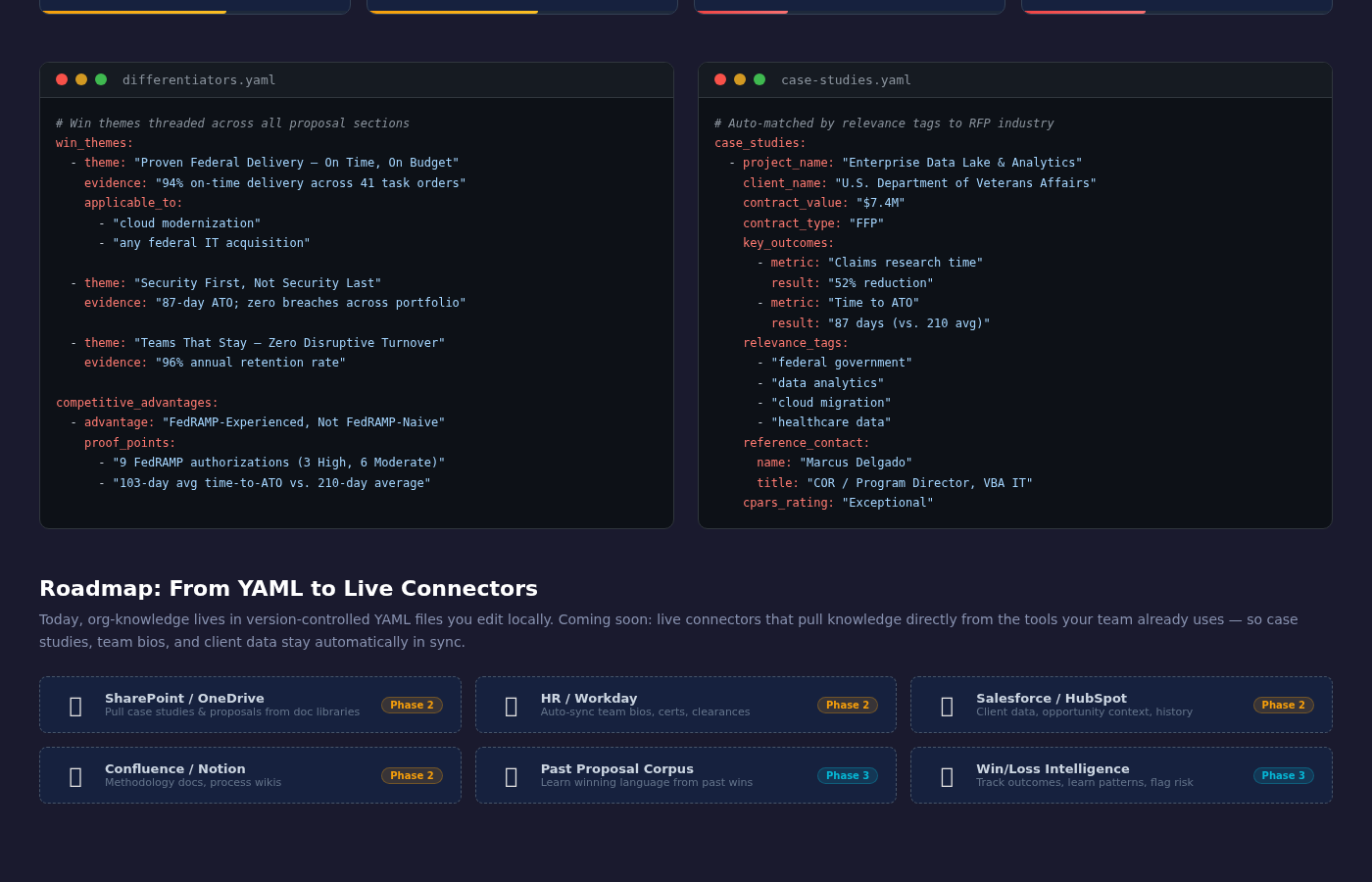
Phase 2 connectors will pull knowledge directly from the tools your team already uses: SharePoint and OneDrive for case study documents, Workday or your HRIS for team bios and certifications, Salesforce or HubSpot for client relationship context, and Confluence or Notion for methodology documentation. No more copy-pasting between systems — org-knowledge stays automatically in sync.
Phase 3 goes further: a past proposal corpus that learns winning language patterns from your actual wins, and win/loss intelligence that tracks which proposals won vs. lost and flags risk early (“RFPs like this have a low win rate for us”).
The YAML foundation means you can start today. The connector roadmap means it only gets smarter.
But First: What is Claude Cowork?
If you’ve heard of Claude — Anthropic’s AI assistant — you’ve probably interacted with it through the chat interface on claude.ai or through the API. But Anthropic has been building something more ambitious: ways for Claude to do real work on your computer, not just answer questions in a chat window.
There are two tools at the center of this:
Claude Code: The Developer’s Power Tool
Claude Code is a command-line interface (CLI) built for software engineers. You install it in your terminal, and Claude can read your codebase, write code, run tests, commit to Git, and debug issues — all from the command line. It’s agentic coding: you describe what you want, and Claude does the engineering work.
Think of it as a senior developer sitting in your terminal, pair-programming with you.
Claude Code is powerful, but it’s designed for people who live in terminals. If you’re a business development manager, a proposal writer, or a consulting director, a CLI tool isn’t your natural habitat.
Claude Cowork: AI for the Rest of the Knowledge Workforce
Claude Cowork is different. It’s a desktop application — a visual, conversational workspace where Claude can do real work with your files, documents, and data. No terminal. No code. Just you and Claude, working together.
Here’s what makes Cowork special:
- It works with your files directly. You can point Claude at a folder on your computer, and it reads, creates, and edits documents right there — Word files, PDFs, spreadsheets, presentations.
- It runs in a secure sandbox. Claude operates inside a lightweight virtual machine on your computer. Your files stay local. Nothing gets uploaded to the cloud unless you explicitly use a cloud connector.
- It has a plugin system. This is the game-changer. Just like how a browser becomes more useful with extensions, Claude Cowork becomes more capable with plugins. Plugins give Claude specialized skills, commands, and integrations tailored to specific workflows.
Cowork is currently in research preview, which means it’s evolving fast — and the plugin ecosystem is wide open for builders.
What is a Claude Cowork Plugin?
A Cowork plugin is a bundle of knowledge, workflows, and tools that makes Claude an expert in a specific domain. Under the hood, a plugin is just a folder containing:
- Skills — Markdown files that give Claude deep domain knowledge.
- Commands — Slash commands (like /generate-proposal or /analyze-rfp) that trigger multi-step workflows.
- Org-Knowledge Files — Configuration files (YAML) that customize the plugin for YOUR organization.
- MCP Servers — Local microservices that give Claude tools it doesn’t natively have.
- Connectors — Optional integrations with external services like Slack, Google Drive, Salesforce, or SharePoint.
No code required to use a plugin. No code required to customize one. If you can edit a YAML file (which looks a lot like filling out a form), you can configure a plugin for your team.
What Makes RFP2Proposal Different?
There are AI tools that help you “write proposals.” Most of them are glorified templates with a chatbot bolted on. RFP2Proposal takes a fundamentally different approach:
It reads the RFP first. Before writing a single word of your proposal, the plugin analyzes the entire RFP document across 12 structured categories — scope, timeline, budget signals, evaluation criteria, compliance requirements, personnel needs, pain points, and more.
It writes to the evaluation criteria. Government and enterprise RFPs score proposals against specific criteria with specific weights. RFP2Proposal detects those criteria and threads your win themes into the sections that matter most.
It knows the difference between what it can write and what it can’t. The plugin uses the three-tier smart placeholder system — REQUIRED, SUGGESTED, and OPTIONAL — so your team knows exactly what needs human attention.
It generates the traceability matrix. RFP2Proposal generates them automatically as a byproduct of the proposal creation process — with 87.5% coverage on the first pass.
It’s yours to own. MIT-licensed, fully open-source, designed to be forked and customized.
Sample Artifacts — Download and Explore
All sample outputs from the Acme Corporation CRM RFP are available for download:
| Artifact | Description | Download |
|---|---|---|
| Input RFP | Enterprise CRM Platform Implementation RFP (Acme Corp) | AcmeCorp_CRM_RFP.docx |
| Generated Proposal | Complete 10-section proposal with smart placeholders | AcmeCorp-CRM-Proposal.docx |
| Traceability Matrix | RFP-to-proposal section mapping with coverage analysis | AcmeCorp-CRM-Traceability-Matrix.xlsx |
Coming Up Next
In Part 2, we’ll dig into the business case: why proposal teams are losing millions in billable hours to manual RFP responses, how RFP2Proposal changes the economics, and what the ROI looks like for consulting and outsourcing firms.
In Part 3, we’ll walk through the full setup — from installing the plugin, configuring your organization’s knowledge base, to generating your first proposal and exporting a polished Word document.
Stay tuned.
RFP2Proposal is an open-source project licensed under MIT. Contributions welcome.
GitHub: github.com/agentbee0/RFP2Proposal
Sources: Market Impact of Claude Cowork
- Anthropic’s Claude triggered a trillion-dollar selloff — Fortune
- Anthropic’s new AI tool sends shudders through software stocks — CNN Business
- Claude Cowork Triggers Tech Stock Selloff — Trending Topics
- Why Claude Cowork is a math problem Indian IT can’t solve — Rest of World
- Nifty IT index crash — Business Today
- Jefferies Downgrades Indian IT Stocks — Business Standard
- The Great Stabilization — FinancialContent
- Anthropic goes from software foe to friend — CNBC
 Agent B
Leave a comment